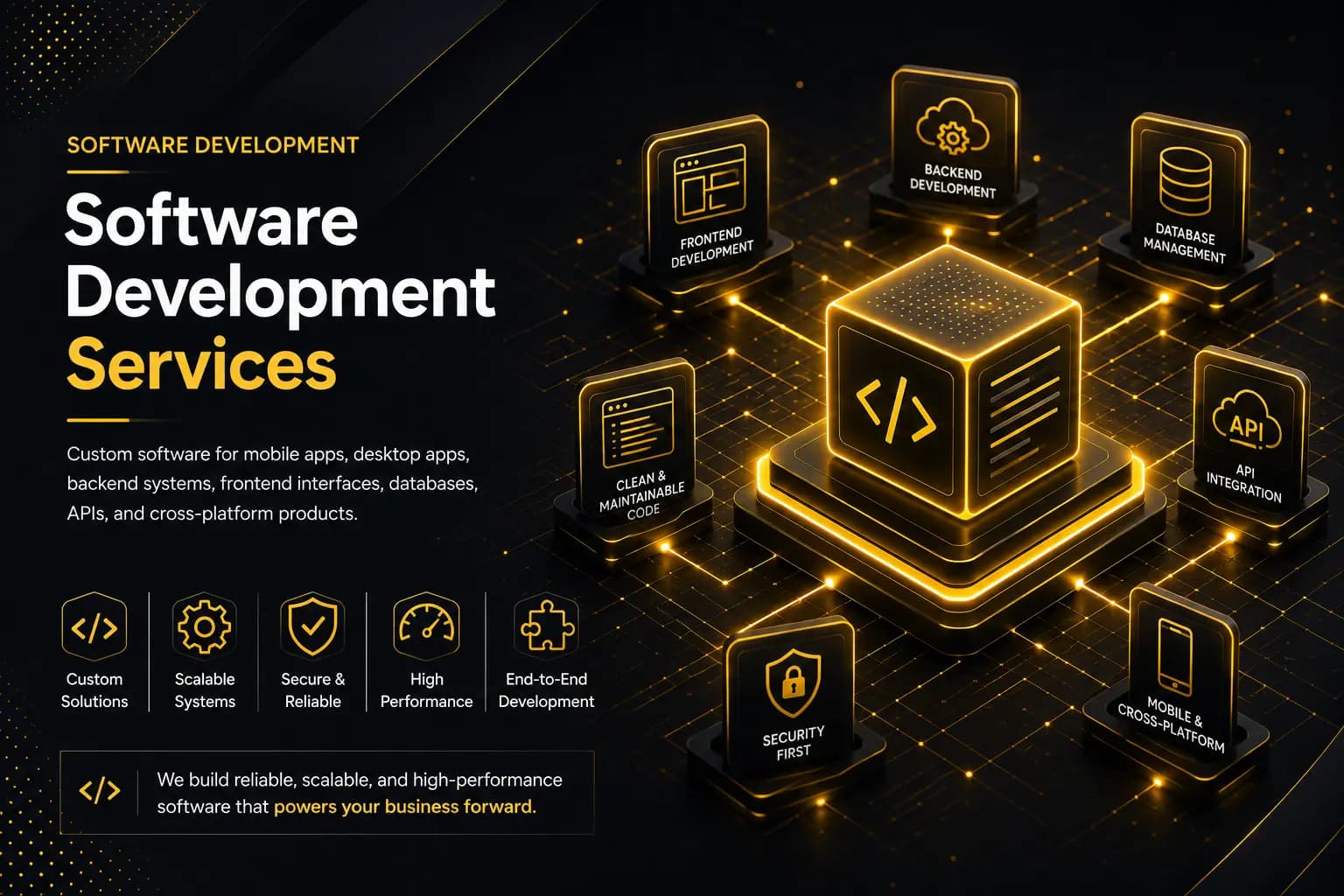
Business-Focused Software Development
Custom software should solve a clear business problem. It may replace repetitive manual work, connect disconnected systems, improve customer service, give employees better operational tools, or create a digital product that generates revenue.
ZAXON develops software around the actual users, workflows, data, permissions, integrations, and operating requirements of the business. Frontend interfaces, backend services, databases, APIs, admin dashboards, automation, and infrastructure can be planned as one connected product.
Engagements can range from a focused feature, API, or automation system to a complete web, mobile, desktop, or cross-platform application with deployment and technical handover.
Business Outcomes
The development process focuses on delivering software that is useful to customers, manageable by administrators, and suitable for continued improvement after launch.
- Replace spreadsheets, manual processes, disconnected tools, or repetitive administrative work with a structured software system.
- Create one connected product across frontend, backend, database, APIs, authentication, administration, and deployment.
- Give employees or administrators practical tools for managing daily operations, users, records, settings, and reports.
- Improve customer experience through clearer user flows, responsive interfaces, faster processes, and self-service functionality.
- Connect existing services, payment providers, APIs, databases, and communication tools into a unified workflow.
- Build a maintainable technical foundation that can support future features, more users, additional integrations, and continued business growth.
Software Development Services
- Custom Business Software: Purpose-built software for internal operations, customer services, administration, reporting, workflow management, data processing, and organization-specific business requirements.
- Web Application Development: Responsive web applications, SaaS platforms, user portals, account systems, dashboards, management tools, and browser-based products designed around complete business workflows.
- Mobile Application Development: Android and cross-platform mobile applications for customers, employees, communities, operations, service delivery, data collection, and connected product experiences.
- Desktop Application Development: Desktop tools, utilities, dashboards, internal systems, offline-capable applications, data-management software, and workflow applications for Windows, Linux, or cross-platform use.
- Backend Development: Backend services for authentication, accounts, business logic, permissions, payments, notifications, file processing, reporting, queues, integrations, and application infrastructure.
- API Development & Integration: REST APIs, internal services, third-party integrations, payment integrations, automation endpoints, data synchronization, webhook processing, and secure communication between systems.
- Database Design & Development: Database schemas, data relationships, migrations, validation, reporting structures, audit records, performance planning, and integration with application and administrative workflows.
- Admin Dashboard Development: Administrative interfaces for managing users, products, orders, settings, payments, content, reports, logs, permissions, support requests, and other operational data.
- Automation & Workflow Systems: Software that reduces repetitive work through scheduled tasks, background workers, notifications, data processing, integrations, approval flows, messaging bots, and rule-based automation.
- Existing Software Improvement: New features, frontend updates, backend changes, performance improvements, API integrations, database work, deployment fixes, architecture changes, and technical maintenance for existing applications.
Typical Project Deliverables
Deliverables are defined before development and depend on the agreed scope. A complete software project may include:
- Requirements review and technical scope.
- Product architecture covering frontend, backend, database, APIs, integrations, infrastructure, and deployment.
- User-facing application interfaces and responsive workflows.
- Backend services, authentication, permissions, validation, and business logic.
- Database schema, migrations, records, and reporting structures.
- Admin dashboard and internal management tools where required.
- Third-party API, payment, messaging, email, storage, or external service integrations.
- Testing of user flows, permissions, data handling, integrations, and important edge cases.
- Production configuration and deployment support within the agreed scope.
- Documentation, repository handover, and post-delivery support based on the selected package.
Development Process
- Discovery and Requirements: Define the business problem, target users, required platforms, core workflows, administrative needs, integrations, priorities, and expected outcomes.
- Technical Architecture: Plan the frontend, backend, database, APIs, authentication, permissions, integrations, infrastructure, deployment model, and long-term maintenance approach.
- Scope and Milestones: Convert the requirements into clear features, deliverables, dependencies, implementation stages, review points, and release milestones.
- Interface and Product Development: Build user interfaces, backend services, database logic, dashboards, integrations, automation, and platform-specific features according to the approved scope.
- Testing and Quality Review: Test user actions, permissions, validation, data handling, responsiveness, integrations, failure states, edge cases, and production-critical workflows.
- Deployment and Handover: Prepare the production environment, configure services, deploy agreed components, provide technical documentation, and complete the project handover.
- Support and Continued Development: Provide support, maintenance, new features, additional integrations, platform improvements, or continued development under a separate agreement.
Architecture, Security & Quality
Reliable software requires more than a working interface. Architecture, permissions, data consistency, validation, background processing, integrations, deployment, logging, and maintainability must all be considered as part of the product.
- Clear separation between frontend, backend, database, integration, and administrative responsibilities.
- Authentication, authorization, user roles, and protected administrative workflows.
- Input validation, structured error handling, and safe processing of user-submitted data.
- Database constraints, migrations, indexing, relationships, and record consistency.
- Protection against duplicate requests, repeated actions, unauthorized access, and invalid workflow states where applicable.
- Background workers, queues, retries, logs, and status tracking for long-running or asynchronous operations.
- API rate limiting, security headers, environment configuration, and production access controls.
- Responsive interface testing across desktop, tablet, and mobile screen sizes.
- Monitoring and logging for important application, integration, payment, and administrative events.
- Development, staging, and production configuration separation when required by the project.
Engagement Models
Projects can be structured as complete product development, focused feature work, an MVP, or technical support for an existing application.
- Full Product Development: Complete implementation covering product planning, frontend, backend, database, APIs, admin tools, integrations, testing, deployment, and handover.
- MVP Development: A focused first version that validates the core business workflow without adding unnecessary features before the product has real users or market feedback.
- Feature or Component Development: Development of a specific dashboard, API, mobile feature, backend service, integration, database workflow, automation process, or other application component.
- Existing Application Improvement: Feature additions, architecture changes, performance improvements, interface updates, integration work, deployment fixes, or backend and database development for an existing codebase.
- Technical Consulting: Feasibility review, architecture planning, technology selection, database design, product scoping, infrastructure guidance, and implementation planning.
- Deployment & Configuration: Production setup for supported applications, including environment configuration, database setup, process management, reverse proxy configuration, domains, and service deployment.
Who This Service Is For
This service is suitable for organizations that need software designed around their own workflows instead of relying on a generic template or disconnected collection of tools.
- Businesses replacing manual operations, spreadsheets, disconnected tools, or repetitive administrative processes.
- Startups building an MVP, SaaS platform, mobile application, dashboard, marketplace, or complete digital product.
- Founders who need a technical partner to turn a product idea into a structured implementation plan and working application.
- Teams that need APIs, integrations, databases, authentication, reporting, automation, or internal management systems.
- Organizations improving an existing software product with new features, better architecture, deployment support, or performance improvements.
- Agencies and development teams that need support with a specific backend, frontend, mobile, database, or integration component.
Technology Areas
The final stack is selected according to the application type, required platforms, data model, integrations, infrastructure, administrative workflows, and long-term maintenance needs.
Related Services & Products
Software projects may also require a public website, blockchain integration, or an existing product that can reduce initial development time.
- Web Development — Business websites, web applications, responsive interfaces, ecommerce, WordPress development, dashboards, and performance-focused frontend work.
- Blockchain Development — Smart contracts, token systems, Web3 applications, wallet integrations, blockchain APIs, automation, and blockchain platform development.
- Products — Ready-made software and blockchain products that can provide a faster starting point than a fully custom development project.
Frequently Asked Questions
- Can ZAXON build a complete software product?
Yes. A complete project can include product planning, frontend development, backend APIs, database design, authentication, user accounts, admin dashboards, integrations, automation, deployment, and technical handover. - Do you develop both frontend and backend systems?
Yes. Frontend interfaces, backend services, APIs, database models, authentication, permissions, administrative tools, integrations, and deployment workflows can be developed as one connected application. - Can you build an MVP for a startup?
Yes. An MVP can focus on the minimum set of features needed to validate the core business idea, user workflow, technical feasibility, or market demand before investing in a larger product. - Can you build mobile applications?
Yes. Mobile development can include Android applications, cross-platform applications, account systems, dashboards, notifications, API integrations, and mobile workflows connected to a shared backend. - Can you develop desktop applications?
Yes. Desktop projects can include business tools, utilities, dashboards, data-management applications, internal systems, and cross-platform desktop software depending on the requirements. - Can you work on an existing software project?
Yes. Existing applications can be reviewed for feature development, frontend changes, backend updates, database work, API integrations, performance improvements, deployment problems, or architectural improvements. - Can you integrate third-party services and APIs?
Yes. Software can be integrated with payment providers, email services, messaging platforms, cloud storage, analytics systems, external APIs, identity providers, webhooks, and other business services.
Project, Delivery & Support FAQ
- Do you build admin dashboards?
Yes. Admin dashboards can be developed for users, products, orders, payments, content, reports, logs, settings, permissions, support requests, and other operational workflows. - Can you automate business processes?
Yes. Automation can include scheduled tasks, notifications, data synchronization, background processing, document workflows, messaging bots, reporting, approval flows, and rule-based actions. - How long does custom software development take?
The timeline depends on the number of platforms, features, user roles, integrations, database complexity, interface requirements, testing, deployment, and documentation. - How is software development pricing calculated?
Pricing is based on the confirmed scope, technical complexity, supported platforms, integrations, user and administrative workflows, testing requirements, deployment needs, documentation, and support period. - Do you provide deployment and post-launch support?
Yes. Deployment can include server configuration, databases, environment variables, process management, reverse proxy setup, domains, SSL, production testing, documentation, and post-launch support. - Will we receive the source code?
Source-code delivery, repository access, ownership terms, documentation, licenses, and third-party dependencies are defined in the project agreement before development begins.
Discuss Your Software Project
Share the business problem, target users, required platforms, expected workflow, current systems, integrations, and project priorities. ZAXON can review the requirements and prepare a technical scope and quote.